How To Light Photography Prints And Artwork
Mastering the art of properly lighting photography prints or artwork on a wall is essential for showcasing the full brilliance of the art. Adequate illumination not only brings out the intricate details and vibrant colours, but also highlights the three-dimensionality that makes the artwork truly extraordinary.
Proper accent lighting is important to give your art piece the attention it deserves. You have to make the choice as to whether you will rely on natural light in the room, or if you will illuminate your art to maximize its potential.

Remember that when you view a picture on a television or computer screen, you are seeing projected light. When you view photographic prints or artwork on a wall, you are seeing reflected light, which is the opposite. Consequently, artworks can appear dark if there is insufficient ambient light, which is why they will always benefit from additional accent lighting.
When they are properly lit, many premium-quality print materials have reactive properties that make them come alive with a glowing response that almost makes them appear back-lit.
Adding this extra accent lighting will put your new art piece at the center stage so it commands attention as a breathtaking focal point in your home, especially in the evening when the ambient light of day has faded away.
This comprehensive tutorial includes all of the information required for your lighting project, and the knowledge you will need in learning how to light your art like a pro and achieve gallery quality results in your home.
Click, hold and slide your cursor back and forth on the arrows in the photo above to see the dramatic difference of effective accent lighting.
During the day, the natural ambient light is sufficient to enjoy the fine details of this fine art print over the fireplace. At night, the purposed accent lighting on the artwork transforms it into a spectacular focal point in the room.
Avoid Letting The Sun Light Your Art
The first and most important consideration is to avoid placing your art on a wall directly exposed to direct sunlight. Despite the UV protection built into the acrylic or laminate of a photograph, sunlight carries infrared radiation and ultraviolet light, which will damage and fade your print. Paintings and other forms of art are equally susceptible to fading when subjected to direct exposure.
With acrylic face mount artworks, the heating and cooling cycles of direct sunlight can also cause materials in your print to expand and contract, which over time may cause them to bubble or delaminate.
Sunlight is an art killer. Avoid direct sunlight at all costs.

Additionally, placing warm accent lights too close to your print can also cause heat damage. Put your hand in front of the print with your lights turned on; if you can feel any heat, your light bulbs are too close.
Finally, never use fluorescent lighting. These bulbs not only emit a lot of ultraviolet light which can cause fading, but the colour of the light distorts the natural colours in your artwork, making them appear unnatural.
Light Bulbs- The Good, The Bad, And The Ugly
As mentioned above, fluorescent lighting can damage your print with UV and cause the colours to look unnatural and even ugly. These include the traditional long linear tube bulbs and compact fluorescent (CFL) bulbs.
Halogen lighting came on to the scene many years ago and was very popular for all types of ambient or accent lighting in your home. But although halogen bulbs do a good job of replicating the colour of natural sunlight and will make your art look great, there is a problem. It's the heat. These bulbs can damage artwork, are inefficient, and are no longer the best choice.

With today's lighting technology, it seems as though there is an endless stream of choices for many applications. But thankfully when it comes to lighting art, there is one choice that stands above the rest- LED bulbs.
Understanding LED Light Bulbs
There are a few important terms to understand when purchasing LED bulbs to illuminate your art, but they are easy to understand. Take a look, and you'll be on the right path.
1. LED BULB TYPE. LED stands for 'light-emitting diode' and is by far the best for your artwork. They are energy efficient, produce very little heat, and are available in a wide range of 'colour temperatures' and 'CRI ratings'. You will learn more about these terms below.

The two most common types of LED bulbs suitable for accent lighting use reflectors in their design to accurately control the 'beam angle' (more on this later). They are PAR bulbs (Parabolic Aluminized Reflector) and MR bulbs (Multifaceted Reflector).
Common names like "PAR20" or "MR16" may sound familiar to you. PAR bulbs will usually have a screw-in style base, while MR16 bulbs may have either a 'GU5.3' push-pin base or a 'GU10' twist/lock style base.
In general, MR16 bulbs can produce reasonable brightness if your bulbs are not too far away from your art. If you need extra brightness, PAR 20 and PAR 30 bulbs are larger and generally much brighter.
2. COLOUR TEMPERATURE. This is a way to describe the appearance of the light provided by a bulb. It is measured in Degrees Kelvin (K) on a scale from 1,000 to 10,000. In a typical residential home, most common bulbs range in temperature from about 2000K to 6500K.

Bulbs in the 2000K to 3000K range have an 'amber' or 'warm white' appearance. Bulbs in the 3100K to 4500K range have a more neutral white colour similar to midday sunlight. Finally, bulbs in the 4600K to 6500K range produce a very crisp light that even has a bluish tint to it.

3. COLOUR RENDERING INDEX. Also known as 'CRI', this is a scale ranging from 0–100 that measures how accurately a light source renders eight specific pastel colors, known as 'R1 to R8' colours, as compared with a natural source like sunlight.
Basically, the higher the CRI number, the more natural the colours will appear in your artwork. A CRI of 85 is good, 90 is even better and 95 or higher is the best.
4. CRI R9. This is a separate measurement of how faithfully the light source will render deep red (R9) colours. R9 is not included in the standard CRI scale, although some percentage of red is present in all of the colours which make up the CRI value.
The ability of a bulb to accurately produce red is important to overall colour rendering so that all of the vivid colours in your artwork will appear in their truest form. A good R9 score is similar to CRI, in that anything over 90 is considered excellent.

5. BEAM ANGLE. This is the set angle of the beam or 'cone of light' coming from the bulb, measured in degrees. The larger the number of degrees, the wider the light beam. Terms like 'spot' or 'flood' along with numbers like 10, 25, 40, 60, etc. are often used to describe the beam angle and are sometimes printed on the box.
Most bulbs can be purchased in a variety of beam angles depending on your needs, but we will get to that later. Also, this term is not to be confused with the fixture angle, which you will learn about below.
6. LUMENS. Back in the old days, we all used incandescent light bulbs where the brightness was measured in watts. A 100 watt bulb was really bright, compared to 75, 60, or 40 watt bulb. Today, the terminology has changed and brightness is now measured in 'lumens'.
For perspective, an old 100 watt incandescent bulb is equivalent to about 1600 lumens. A 75 watt bulb is about 1100 lumens, a 60 watt bulb is 800 lumens and a 40 watt bulb is around 450 lumens.
And today, watts are a measure of how much energy the bulb consumes, not how bright it is.
Where To Install Your Light Fixtures
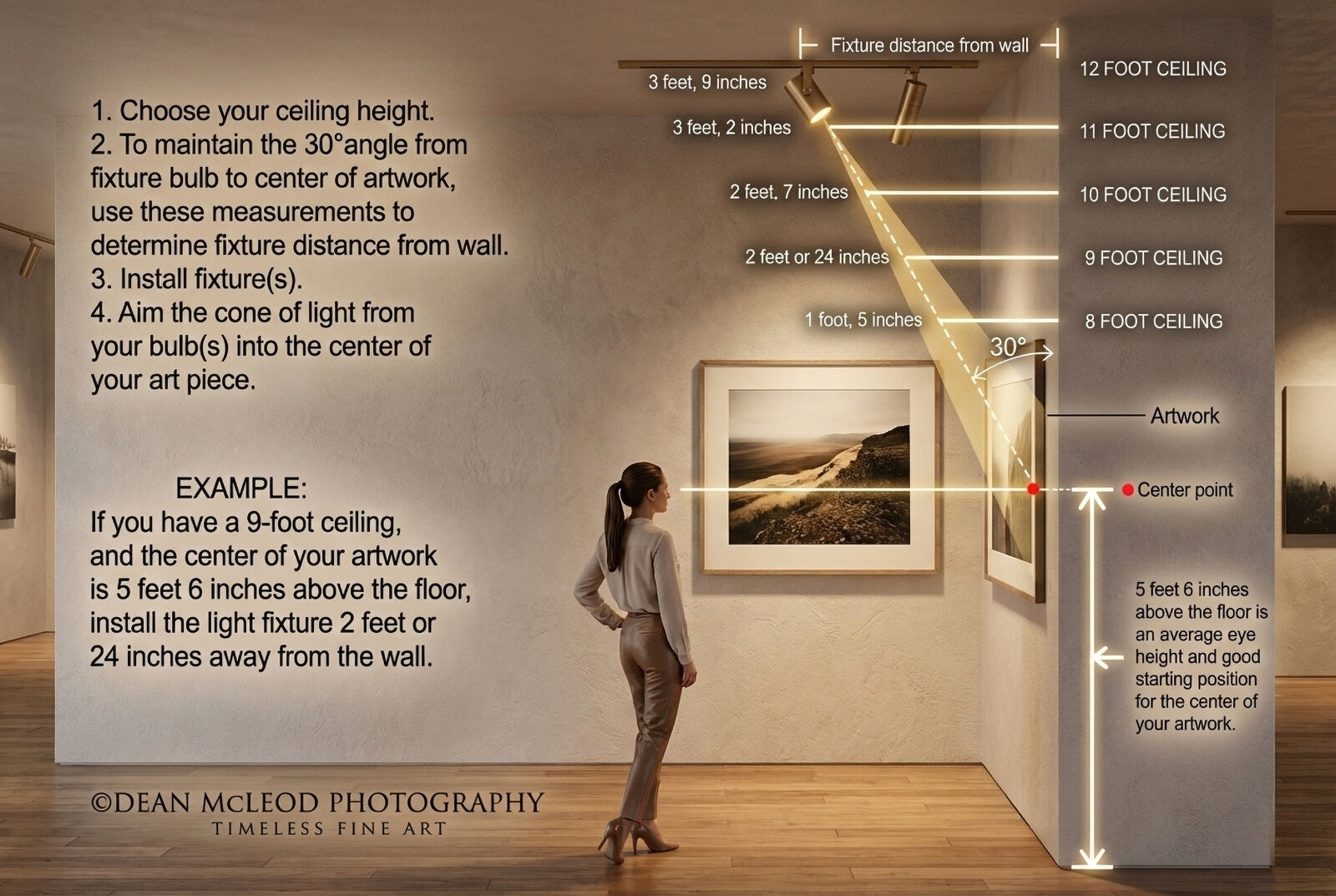
Museums and galleries around the world agree that when illuminating art on your wall, it will look it's best if the fixture(s) are angled at approximately 30 degrees from vertical. The reason for this is twofold; it will help to prevent the viewer from seeing the reflection of the light bulbs on the shiny surface of the artwork, and it will also prevent casting a shadow of your own head on the art when you art standing in front of it.
Consequently, different ceiling heights will require you to install your fixture at varying distances from the wall in order to maintain the 30° fixture angle. Hanging the art on your wall such that the very center of it is approximately eye-height (or 5 feet 6 inches off the floor) is a good place to start.
As this may not always be possible, and you are hanging it HIGHER, then you would install the light fixture SLIGHTLY CLOSER to the wall. Conversely, if you are hanging the art SLIGHTLY LOWER, then you would install the fixture SLIGHTLY FURTHER from the wall.
The diagram below makes these principles easy to understand.
Basic Styles Of Light Fixtures
There is a vast array of lighting fixture styles available today that are able to illuminate your artwork, and the choices can be dizzying. Rest assured, we can break them down into four basic categories, which may assist you in deciding what is right for your space.
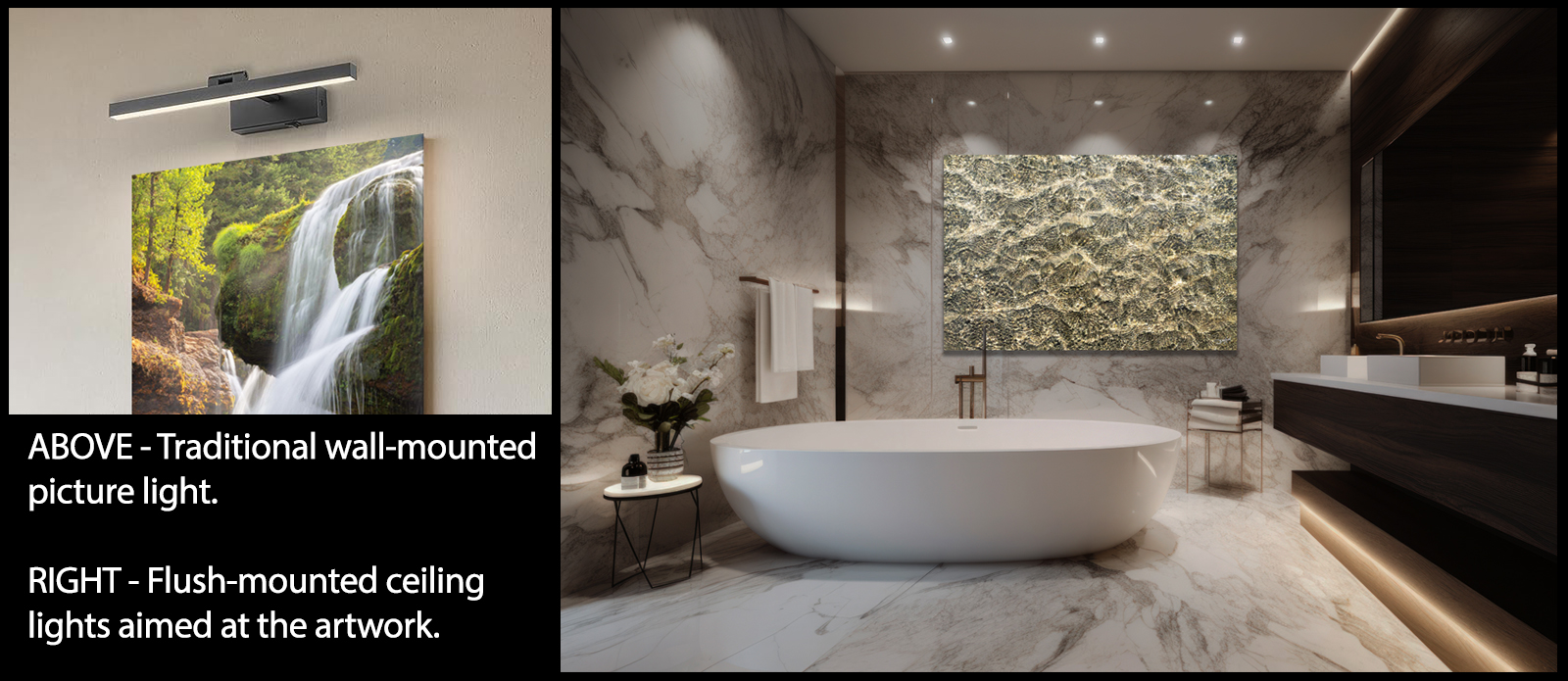
1. Picture lights. These are the decorative fixture style that you may have seen in a museum, attached to the wall, or even onto the frame of a painting. Remember that they need a power source, so they will need to be either hard-wired into your wall or plugged into a nearby outlet with a cord.
2. Ceiling mounted lights. These fixtures can be mounted on the surface or recessed into the ceiling for a flush, discreet look. You'll want a 'gimbal' or 'swiveling' style that can be aimed to provide light in the direction that you need it. These are probably the most labor-intensive to install, as you'll often be cutting into your ceiling drywall to place them, and once they are there, may not be as versatile if you choose to move your art or change your mind later. But for a sleek look, they are hard to beat.
3. Track or swivel fixture lights. Small tracks of varying lengths can be installed on your ceiling using a single receptacle, after which one or more fixtures are attached to the track. Swiveling fixture heads look similar, but without the track and require a separate ceiling receptacle for each unit.
This is probably the most versatile setup for lighting art, as the fixtures can be angled in almost any direction, offering a lot of flexibility. Also, they are available in a variety of designs and colours to suit any interior.
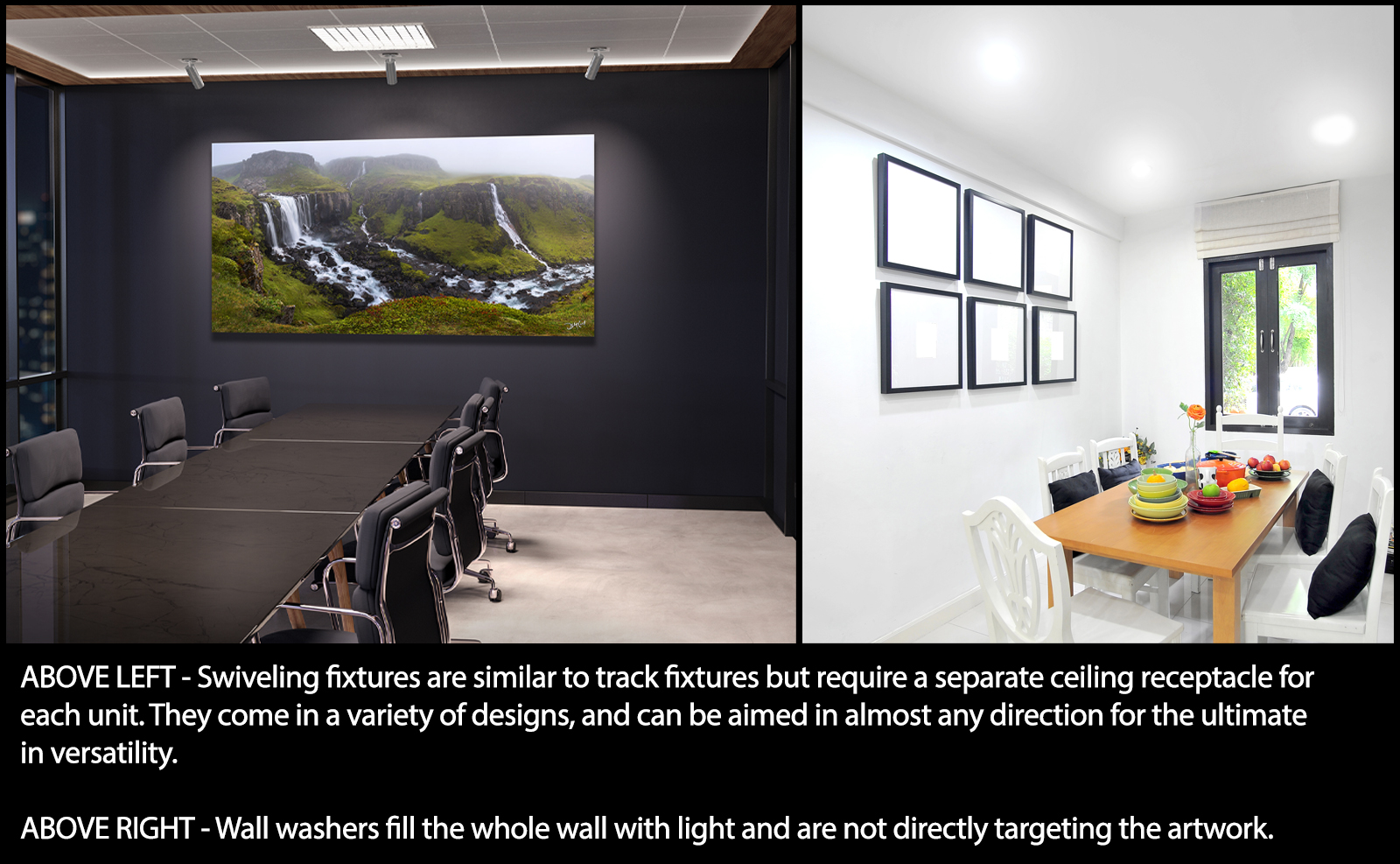
4. Wall washers. These are fixtures that can be mounted to a ceiling, wall, or even the floor to cast a large volume of light over the entire wall, rather than shining a focused beam in one particular area. If you are not concerned with targeting your artwork directly, and just prefer to place it on a well-lit wall, this is always an option.
Understanding Beam Angles
Now that you have your artwork placed on the wall at the correct height, installed your light fixture(s) at the right distance from the wall, and pointed them down at 30 degrees towards the middle of your art piece, we have one final step- and that is to purchase your new bulbs with the proper beam angle to achieve even coverage of light on the artwork.
As we said previously, this is the set angle of the beam or 'cone of light' coming from the bulb, measured in degrees.

In terms of the beam angle, there are two basic factors that will determine which bulbs are the right ones for your space; the distance of the bulbs to the artwork, and the size of the artwork. The chart below illustrates how the 'beam spread' increases in size the further away the artwork is from the lightbulb.

Next, the size of the artwork will determine which beam angles are best, as well as estimating how many fixtures are necessary to evenly illuminate your artwork. For example, if your art piece is perfectly square, you may be able to light it quite evenly with just one fixture.
But if your art piece is landscape oriented, portrait-oriented, or even a panoramic style, you will need at least two or maybe even three or more fixtures to light it evenly edge to edge.
It is important to note that the chart above shows hard-edged pools of light for illustration purposes, but in reality, light beams are brightest in the middle and usually have soft, feathered edges that fade in intensity.
Choosing The Beam Angle For Your Space
Let us work through an example together, and say that you have a 40"x60" artwork (or 3 feet, four inches tall by 5 feet wide). You measure and determine that the distance from the bulbs to the center of the art piece is about five feet.
Using the chart below, you would use the 'five feet away' column because your bulbs are five feet from the surface of the art. Your art is 3'-4" tall, so move down the column until you find a beam spread size which is close to the height of your artwork.

The 40° bulb would cast a beam that is 3'-7" in size which is TALL enough, but not WIDE enough for your print, so you know that you need at least two bulbs (in two fixtures) to evenly illuminate your print top to bottom and side to side.
Two 40° bulbs, with one aimed to the left side of your print and the other aimed to the right, with an overlap in the middle would be the perfect choice for this scenario. Remember that light beams have soft, feathered edges so the slight overlap of light from each bulb in the middle of your art will not cause any issues and will blend very naturally.
A Summary Of The Basics
Now that you have gained some insight on the various aspects of lighting, here is a summary of points to remember before you start your new accent lighting project.
1. NEVER hang artwork or photographs on a wall that receives direct sunlight, even if it is only an hour per day.
2. ALWAYS hire a qualified professional when installing new light fixtures or dimmer switches. Working with electricity is dangerous.
3. Make sure the bulbs you purchase check the boxes in the diagram below.
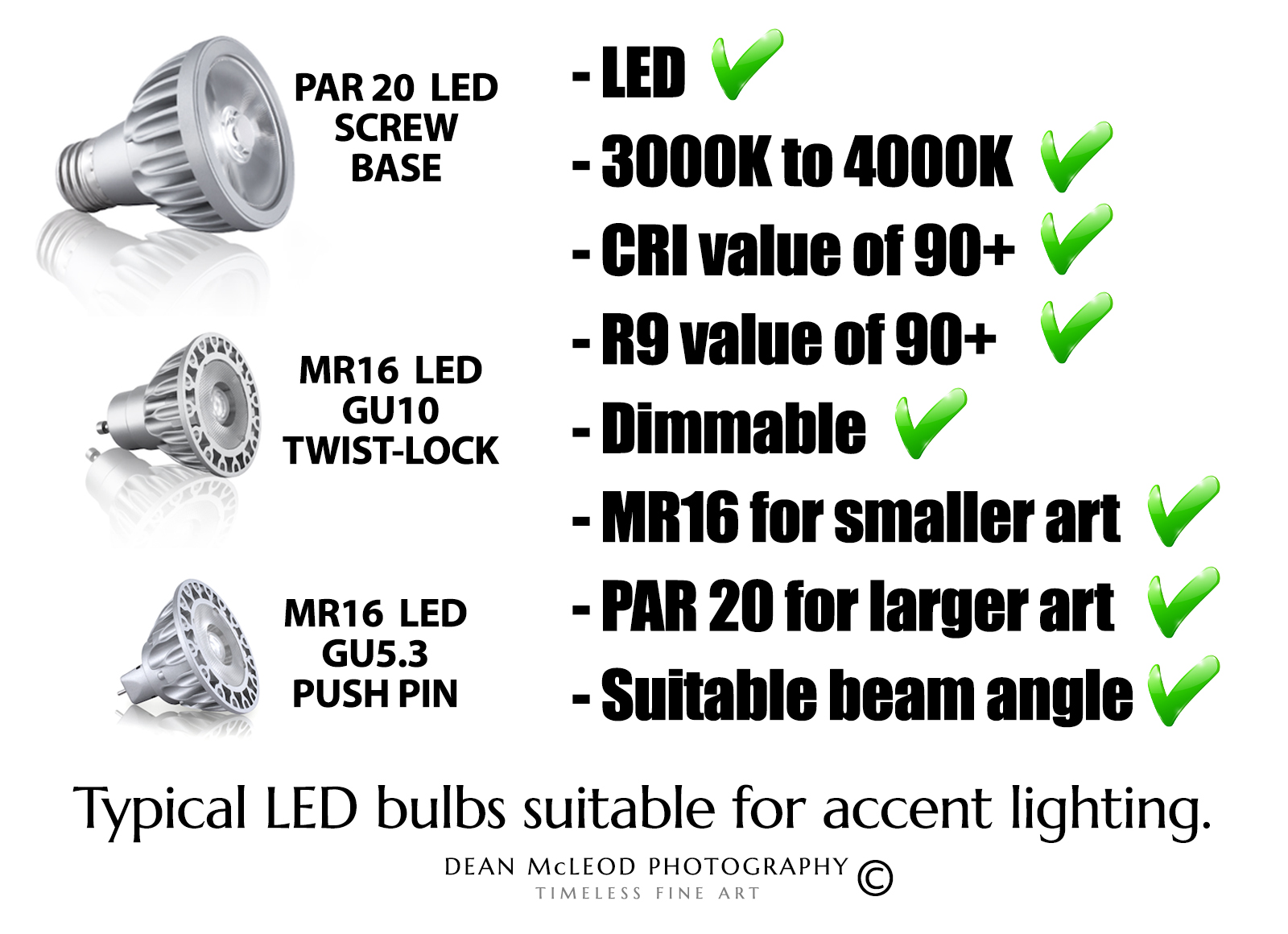
4. Light fixtures are designed to accept one type of bulb (think screw-in base, push-pin base, or twist-lock base). BE SURE that the fixtures and bulbs you purchase are compatible. It may be wise to consult a professional.
5. If you choose ceiling mounted light fixtures (either surface mounted or flush mounted), be sure that once installed, you are able to swivel or aim them near that 30-degree angle that you are targeting. Some fixtures cannot be aimed, depending on the design.
6. I highly recommend using a dimmer switch in your new accent lighting circuit (this is why you need dimmable bulbs). It will give you much more control over the brightness of your artwork and the ambiance of the room. If you feel that the bulbs are too bright, you can easily turn them down with a dimmer.
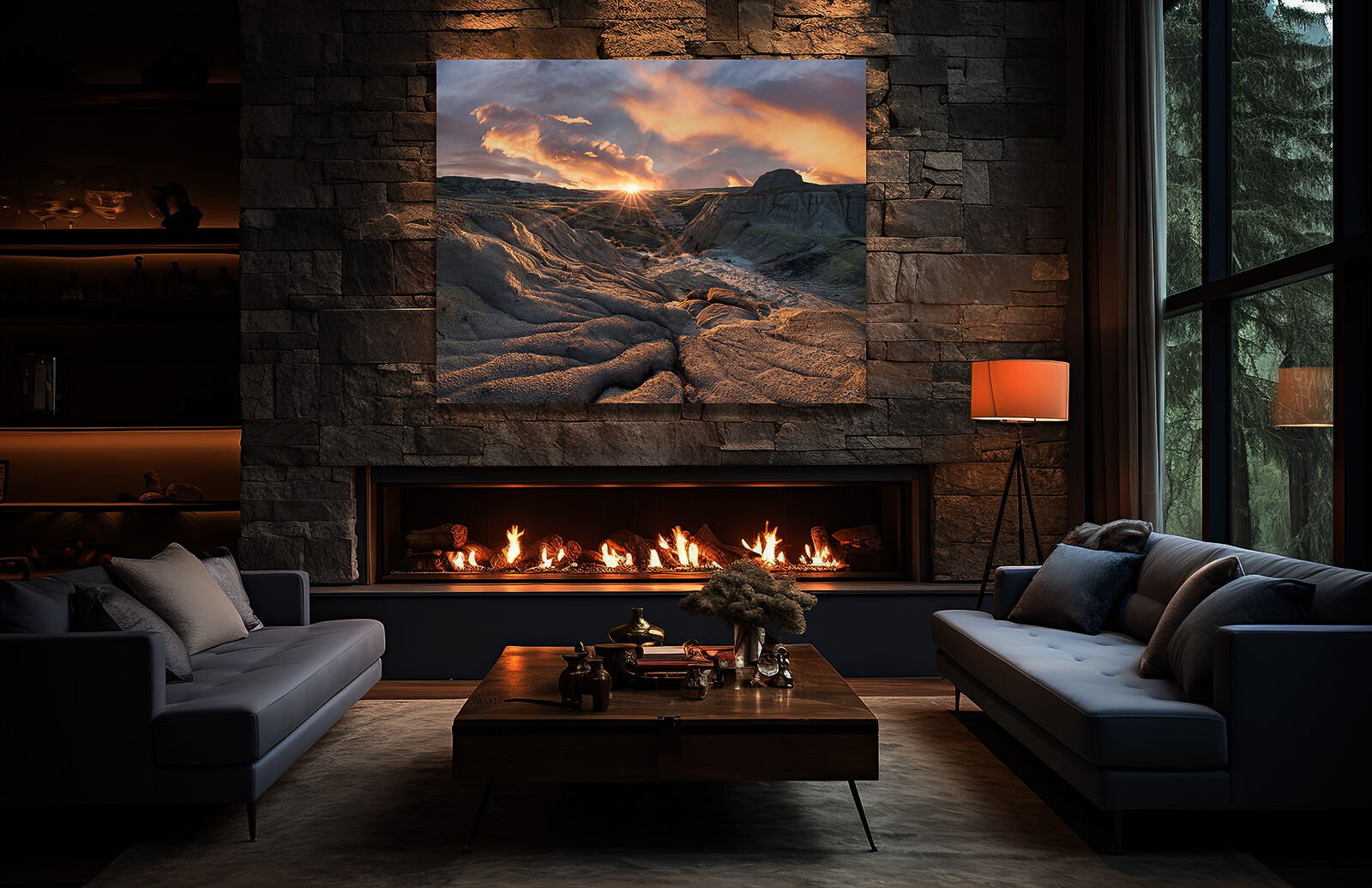
And, if you already have some ceiling lights in the room for general illumination, you can also swap your standard on/off switch for a dimmer switch at a reasonable cost. Make sure your old bulbs are dimmable too, but if not, you can easily change them.
Having full control over all of your room lighting gives you the ability to create the perfect atmosphere and ambiance in any room, while making your artwork the prominent focal point.
Making It All Easy
It is important to point out that the vast majority of mass-produced lightbulbs found in big-box stores are not the ones you want to purchase, in most cases. These bulbs are designed for general illumination in your home, not for pointing at fine art.
Cheap bulbs are easy to spot because the CRI and R9 ratings are usually not printed on the box, and sometimes the beam angle or colour temperature isn't even listed. They will use terms like 'flood' or 'cool white' instead, which is not specific enough. Suffice it to say that if you have invested in fine art, it deserves to have quality illumination to maximize its beauty.
To that end, I have listed some sources below where you can find excellent quality bulbs which will render the colours in your art as accurately as possible. I have absolutely no affiliation with any of these companies, and simply recommend these sources due to their expertise in the field of LED lighting.
For a versatile product line, SORAA® is a California company manufacturing world-class LED bulbs for a variety of applications. Their VIVID® series is a nice lineup of dimmable, high CRI and R9 rated bulbs in a variety of temperatures and beam angles. These bulbs are reasonably priced and simple to order online from a variety of bulb dealers.
Lumicrest Professional LED Lighting, a Canadian company, are a retailer of high CRI dimmable LED bulbs in a few styles. My favourite is their Apturi III Beam-Adustable LED High CRI Dimmable Track Light®, which has an adjustable beam angle of 10 to 60 degrees, a CRI of 97, and is available in a number of colour temperatures and is compatible to three different track systems. They also retail integrated track light fixtures, track systems, and dimmers for one-stop shopping.
A New York company called Tailored Lighting, Inc. are the manufacturers of the ColorView LED Artlight®, a track light fixture with a bulb featuring a temperature of 3150K, a CRI of 94 and a continuously adjustable beam angle from 12 degrees to 60 degrees. Although they retail in the higher end of the price range, if you want the ultimate in flexibility, this light may be an option.
A Final Note
Remember to consult with an expert to be sure that your chosen bulbs will be compatible with your light fixture of choice. Do your homework first, and have a solid plan for your project before you begin purchasing anything.
Quality accent lighting is essential for maximizing the beauty of your art and has the power to transform a room. It will always be well worth the effort.
If you found this lighting guide useful, please recommend and share it to your friends. I wish you the best of luck in illuminating your beautiful works of art!